Table of Contents
ToggleSEO, AEO, GEO and AI Overviews: The Complete Search Strategy for 2026
By Muhammed Ashir
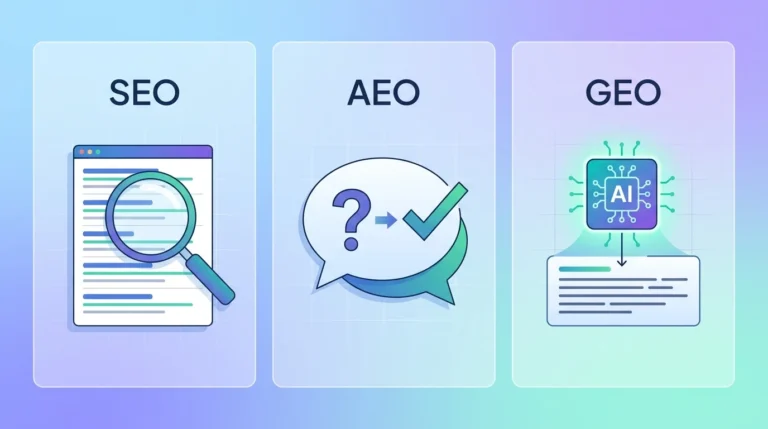
If you’ve spent any time reading about search marketing lately, you’ve probably run into three new acronyms: SEO, AEO, and GEO. Add Google’s AI Overviews into the mix, and it’s easy to feel like everything you knew about ranking on Google is suddenly outdated.
It isn’t. What’s actually happening is simpler than it sounds. Search is expanding to include AI-generated answers alongside traditional results, and that means the way people find information is changing. But the foundation that makes any of this work — helpful, well-structured, trustworthy content — hasn’t gone anywhere.
This article breaks down what SEO, AEO, and GEO actually mean, how AI Overviews fit into the picture, and how to build a search strategy that works across all of them in 2026.
Search Is Changing, But SEO Is Not Disappearing
Search results today look different from five years ago. You might see a traditional list of blue links, an AI-generated summary at the top of the page, a featured snippet, or an AI Mode conversation panel — sometimes all in the same session.
This has led to a wave of new terms: Answer Engine Optimization (AEO) and Generative Engine Optimization (GEO). Some marketers talk about these as if they replace SEO entirely. They don’t. Google itself has been clear that the same fundamental best practices that helped pages perform well in traditional search also apply to how content appears in AI Overviews and AI Mode — there’s no separate, secret ranking system just for AI search.
Think of it this way: SEO is still the foundation. AEO and GEO are ways of thinking about how that foundation shows up in newer search experiences. Understanding all three helps you build a website that performs well no matter how someone searches.
What Is SEO?
SEO stands for Search Engine Optimization. In simple terms, it’s the practice of improving your website so it shows up when people search for things related to your business on Google and other search engines.
.
How SEO works
SEO works by helping search engines understand what your page is about and whether it’s worth showing to someone with a particular question. This involves several layers working together: the words on your page, how your site is structured, how fast it loads, and how trustworthy it appears based on things like backlinks and content quality.
What SEO focuses on
Traditional SEO covers a wide range of areas, including:
- Keyword research and search intent
- On-page content quality
- Technical SEO (site speed, mobile-friendliness, crawlability)
- Site structure and internal linking
- Backlinks and authority signals
If you want a deeper look at where SEO commonly breaks down, I’ve written about common reasons a website does not rank on Google, which covers a lot of the practical side of this.
Why SEO still matters
Even with AI Overviews and AI Mode becoming more common, most search journeys still start with a traditional query, and organic listings remain a major source of website traffic. AI-generated answers often pull their information from well-optimized, authoritative pages — which means strong SEO is often a prerequisite for showing up in AI search results, not a separate track. If you’re new to the topic, this piece on what SEO is and why your business needs it is a good starting point.
What Is AEO?
AEO, or Answer Engine Optimization, is the process of structuring and improving content so answer-focused search systems can understand and use it when responding to user questions.
How AEO works
AEO focuses on making your content easy to lift out and present as a direct answer. This usually means writing clear, concise explanations, using descriptive headings, and answering common questions in a way that doesn’t require the reader to dig through paragraphs of context first.
AEO and direct answers
The idea behind AEO isn’t new. It’s closely related to how Google has handled featured snippets for years — pulling a short, direct answer from a page and displaying it prominently. AEO simply extends that same thinking to newer formats, like voice assistants and AI-generated summaries.
Featured snippets, voice search, and conversational queries
People increasingly search using natural, conversational language — asking full questions instead of typing short keyword phrases. AEO-friendly content anticipates this by answering specific questions directly, often in a question-and-answer format, which also happens to work well for voice search results.
What Is GEO?
GEO, or Generative Engine Optimization, refers to writing and structuring content in a way that makes it easier for generative AI systems to understand, summarize, and potentially reference when generating answers.
How GEO works
GEO isn’t a technical checklist you complete once. It’s more about the depth and clarity of your content. AI systems tend to draw on sources that explain a topic thoroughly, use precise terminology, and connect related ideas logically — rather than pages that skim the surface.
GEO and AI-generated answers
It’s worth being upfront about something: there is no confirmed, official “GEO ranking factor” that guarantees a page gets cited in an AI-generated answer. GEO is an industry-created term describing a set of content practices, not a formal system with defined rules. Adding special markup or following a GEO checklist does not guarantee inclusion in AI search results.
Brand mentions, citations, and AI search visibility
That said, being mentioned or cited by generative AI tools is generally influenced by the same signals that make a page trustworthy to begin with — clear expertise, original explanations, and content that’s genuinely useful rather than a rehash of what’s already online. Building topical authority over time is a more realistic goal than chasing individual AI citations.
What Are Google AI Overviews?
AI Overviews is a Google Search feature that generates a summarized answer to a query, drawing on information from multiple web sources, and displays it near the top of the search results page — often above traditional organic listings.
How AI Overviews are different from traditional search results
A traditional search result is a list of links you click through to read. An AI Overview instead synthesizes information from several sources into a single summary, with links to supporting pages included alongside or within it. AI Mode goes further, allowing a more conversational, multi-turn search experience.
How websites can appear as supporting links
Pages that appear as supporting links within AI Overviews are generally pages that already rank well organically and clearly answer the underlying question. There’s no separate submission process or special schema markup that guarantees a page gets pulled into an AI Overview.
Why strong SEO foundations still matter
Google has stated that the same core ranking systems used for traditional search results are involved in generating AI Overviews, and that there are no additional technical requirements specifically for appearing in these features beyond standard SEO best practices. In other words, if your technical SEO, content quality, and relevance are solid, you’re already doing what’s needed to be eligible.
SEO vs AEO vs GEO: What Is the Difference?
Here’s a simple side-by-side comparison to help clarify how these approaches differ in practice.
| Area | SEO | AEO | GEO |
|---|---|---|---|
| Main focus | Ranking in traditional organic search results | Being selected as a direct answer to a question | Being understood and potentially referenced by generative AI |
| Search experience | Blue-link results pages | Featured snippets, voice assistants | AI Overviews, AI Mode, AI chat tools |
| Typical query | Keyword-based (“best plumber Chennai”) | Question-based (“how do I fix a leaking tap”) | Complex or exploratory (“compare tank sensor types for home use”) |
| Content approach | Keyword targeting, technical SEO, authority building | Clear, direct answers with descriptive structure | Depth, original explanation, topical connections |
| Example | Ranking a service page for a local keyword | Answering “what is X” in the first sentence | Being cited as a source in an AI-generated summary |
None of these approaches works in isolation. A page that ranks well organically is also more likely to be pulled into a featured snippet or an AI-generated answer.
How SEO, AEO, GEO and AI Overviews Work Together
It’s easy to picture these as separate systems, but that’s not really how search engines work. They’re better understood as overlapping layers built on the same foundation.
Strong technical SEO makes your site crawlable and fast. Good content structure and clear answers make it easier for both people and answer engines to find what they need. Depth and topical authority make your content more likely to be a source that generative AI systems draw from. Each layer supports the next — none of them functions well without the others.
A useful way to think about it: SEO gets your content discovered and trusted. AEO makes it easy to extract a direct answer. GEO reflects the overall depth and clarity that makes content worth referencing at all, whether that’s by a person, a snippet, or an AI system.
How to Build a Modern Search Strategy in 2026
Rather than treating SEO, AEO, and GEO as separate projects, it helps to build one strategy that naturally covers all three. Some practical areas to focus on:
- Search intent – Understand what the person is actually trying to accomplish before writing anything.
- Helpful content – Write to genuinely answer a question, not just to include keywords.
- Topical authority – Cover a subject thoroughly across multiple related pages rather than one thin article.
- Internal linking – Connect related pages so both users and search engines understand how your content fits together.
- Technical SEO – Keep your site fast, mobile-friendly, and easy to crawl.
- Structured content – Use clear headings, short paragraphs, and logical flow.
- Question-based content – Address the specific questions your audience is actually asking.
- First-hand insights – Share genuine knowledge and practical reasoning, not recycled explanations.
- Trustworthy sources – Reference reliable information when making factual claims.
- Content depth – Go beyond a basic definition and explain the “why” and “how.”
- Regular updates – Revisit important pages when information changes or becomes outdated.
If this feels like a lot to manage alongside running a business, this is exactly the kind of work I help clients with through my SEO services.
How to Optimize Content for AI Search
A few practical habits can make your content easier for AI systems to understand and potentially use, without promising any guaranteed outcome:
- Answer important questions directly in the first sentence or two, then expand with detail.
- Use descriptive, specific headings instead of vague ones.
- Define technical terms in plain language the first time you use them.
- Keep paragraphs focused on one idea at a time.
- Use comparison tables or lists where they genuinely help clarify information.
- Make sure your content reflects real understanding of the topic, not a surface-level summary.
None of these steps guarantee that your content will be cited in an AI Overview or a chatbot response. They simply make your content clearer and more useful — which happens to align with what both people and AI systems respond well to.
Common Mistakes to Avoid With AEO and GEO
As these terms have gained popularity, some common mistakes have become more visible:
- Stuffing content with keywords instead of writing naturally
- Publishing generic, AI-sounding content with no real insight
- Writing purely for rankings instead of for the reader
- Copying competitor content structure instead of developing original explanations
- Adding FAQ sections with vague, low-value questions just to “do AEO”
- Believing that adding special AI schema markup guarantees AI Overview visibility
- Ignoring technical SEO because “AI search is different now”
- Ignoring page experience and usability
- Publishing content that doesn’t actually help the reader
Avoiding these mistakes matters more than chasing any specific tactic.
Which Strategy Should a Business Focus On?
There’s no universal answer here, and any article that tells you otherwise is oversimplifying. The right mix of SEO, AEO, and GEO thinking depends on your business type, your audience’s search behavior, your current website quality, and your goals.
A local service business might get the most value from strong local SEO and clear, answer-friendly service pages. A brand trying to build broader industry authority might invest more in in-depth, topically connected content that supports GEO-style visibility. Most businesses benefit from a blend of all three, applied consistently over time.
Frequently Asked Questions
What is the difference between SEO, AEO, and GEO?
SEO focuses on ranking in traditional search results through keywords, technical optimization, and authority building. AEO focuses on structuring content so it can be used as a direct answer, such as in featured snippets or voice search. GEO focuses on making content clear and authoritative enough for generative AI systems to potentially reference. They overlap heavily and work best together rather than as separate strategies.
Is SEO still important with AI Overviews and AI search?
Yes. Google has confirmed that AI Overviews rely on the same core ranking systems used for traditional search, and there’s no separate technical requirement for appearing in them. Strong SEO — technical health, relevant content, and authority — remains the foundation that AI search features build on, not something AI search is replacing.
How can I optimize my website for Google AI Overviews?
Focus on the same fundamentals that support good SEO: fast, crawlable technical setup, clear and well-structured content, direct answers to common questions, and genuine topical depth. There’s no special markup or submission process that guarantees inclusion. Being eligible for AI Overviews largely comes from being a strong, trustworthy source in regular search results.
Can AEO and GEO replace traditional SEO?
No. AEO and GEO describe how content performs in newer answer-based and AI-driven search experiences, but they depend on the same underlying SEO fundamentals — crawlability, relevance, and authority. Treating them as replacements for SEO usually leads to weaker results across the board, since none of these systems work well without a solid technical and content foundation.
How do I improve my website’s visibility in AI search results?
Prioritize genuinely helpful, well-structured, accurate content that clearly answers real questions your audience is asking. Build topical depth across related pages, keep your technical SEO solid, and reference trustworthy sources when making factual claims. There’s no shortcut or guaranteed tactic — visibility tends to follow from consistently strong content over time.
Final Thoughts
Search is becoming more conversational and more AI-assisted, but the core principles behind good visibility haven’t changed. Build content for people first. Make it easy for search engines and AI systems to understand. Answer real questions clearly. Focus on building trust and topical authority, and keep improving your website as things evolve.
You don’t need to chase every new acronym or trend to do well in search. A solid SEO foundation, combined with clear, genuinely useful content, will keep serving you well whether someone finds you through a traditional search result, a featured snippet, or an AI-generated summary.
If you’d like help putting a strategy like this together for your own website, feel free to get in touch — or learn more about my background in SEO and digital marketing first.